
Before a student surgeon in ancient India was allowed near a patient, he practiced on fruit, vegetables and leather. To learn the different cuts, the old surgical book says, he should make them in a gourd, a watermelon or a cucumber. To learn to open a swelling, he should cut into a leather bag full of water or slime. He opened veins on lotus stems, pulled seeds out of a jackfruit, stitched cloth and leather, and tied bandages on a life-size doll stuffed with cloth. A student who has practiced like this, the book promises, won’t lose his nerve when the real thing comes.
That advice is about two thousand years old, and it would still make sense in a medical school today, where students practice their stitches on pads and models long before they stitch a person. It comes from a book that every history of surgery mentions, whose oldest dated copy is in Kathmandu, and one of whose operations, the making of a new nose, has a famous later life in London.
A surgeon’s book
The book is Sushruta’s, and beside Charaka’s, the subject of Chapter 5, it is one of the two great early books of Ayurveda. Where Charaka is mostly about medicines and diet, this one is first of all about surgery. Like Charaka’s, it was made in layers. Scholars think it was begun in the last centuries BCE and reworked by about the third or fourth century CE, that a later hand added a long final part, more than a third of the whole, and that it was edited again centuries after that. Whether a man called Sushruta ever lived, nobody can say; the book itself doesn’t show that whoever composed it was called that.
In the book, a teacher speaks to his students, and one of them is Sushruta. The teacher is a king of Kashi, today’s Varanasi, and in the printed versions of the book he is also a god, physician to the gods, born on earth: nearly every chapter opens by saying that the god taught it. The king is दिवोदास (Divodāsa), the god धन्वन्तरि (Dhanvantari).
In Sanskrit it is the सुश्रुत संहिता (Suśruta Saṃhitā). In the Nepali dictionary, सुश्रुत also means “well heard”, which suits a teaching passed from teacher to student by ear. The surgeon’s work is called शल्य (śalya), and the dictionary’s first meaning for that word is a thorn. The book explains why: a शल्य is anything lodged in the body that causes pain, a splinter, an arrowhead, a stone, a dead baby, pus, and surgery is the art of getting it out.
Of medicine’s eight branches, the book puts surgery first, as the oldest. Another branch, शालाक्य (śālākya), named after a thin metal rod, treats everything above the collarbones: eyes, ears, nose, mouth and throat. CDC’s Grade 12 Ayurveda course teaches the two together, with the book’s eight acts of surgery: cutting off, cutting open, scraping, puncturing, probing, extracting, draining and stitching.
What its surgeons did
The most important instrument, the book says, is the hand, because every other instrument depends on it. The blunt instruments it sorts into kinds: forceps, tongs, tubes, rods and more. Many of the forceps had jaws shaped like the mouths of animals and birds, and the book names them: the lion, the tiger, the wolf, the bear, the jackal, the crow, the heron, the owl and many more. The best of all, it says, is the heron’s beak, because it goes in and comes out easily and can draw a thorn from anywhere. The sharp instruments should be made by a skillful blacksmith from good iron, ground fine enough to cut a hair in two.
The book’s surgeons lanced abscesses, took out stones from the bladder, pulled out arrowheads, drew out babies that had died in the womb, and treated wounds with heat and with caustic pastes. They used leeches to draw blood. Before an operation, the book says, the patient should be given a meal, so that he won’t faint, or, if he was used to drinking, strong wine, so that he won’t feel the pain so much.
It also tells a surgeon to know the body from the inside, and how to find out. Take the body of someone who didn’t die old or of poison or a long illness, it says, wrap it in grass, put it in a cage in a quiet pool, and leave it for seven days. Then scrape away the softened skin and flesh, layer by layer, with a brush of grass roots or bamboo, and see each part with your own eyes.
The book’s best-known eye operation is for what it calls लिङ्गनाश (liṅganāśa), the clouding over the pupil that we call a cataract. The patient sits looking at the tip of his own nose. The surgeon holds the eyelids apart and pushes a fine, barley-tipped needle into the white of the eye at the side, avoiding the blood vessels. A small sound and a drop of fluid tell him he is in the right place. Then he uses the tip to scrape the cloudy matter away from the center of the eye, until it shines like a cloudless sun and the patient can see shapes again. The eye is bandaged, and the patient must lie still for days, without coughing or sneezing.
Historians of eye surgery count this as couching: moving the cloudy lens out of the way instead of taking it out. Couching is still done by traditional healers in some poorer countries. Two small studies in Nigeria, of people who came to eye clinics after it, found most of their eyes blind or nearly so, and even with glasses many stayed blind; they counted only those who came, not everyone couched. Today a cataract is taken out through a small cut, and a plastic lens is put in its place. Short trials in India, Nepal and South Africa found that the cheaper way of doing it, by hand, gives about as good sight with glasses as the more expensive machine, which matters in busy eye camps.
The book is just as careful about ears. It says how to pierce a child’s earlobes, with the child on a nurse’s lap, distracted with toys, the needle passed through the thin spot that shows when sunlight shines through the lobe. A lobe could tear right through, and for mending a torn one the book gives fifteen different ways.
Then the nose. Cutting off a nose was an old punishment, in India and elsewhere, and the book tells how to make a new one. Take the leaf of a creeper and cut it to the size of the missing part. Lay it on the cheek and slice off a piece of living flesh the same size. Scrape the stump of the nose raw, put the flesh in place quickly, and fix it with a good bandage. Put two small tubes into the nostrils so the patient can breathe and the new nose doesn’t sag. Dust it with powders, cover it with cotton soaked in sesame oil, and, once it has healed, trim it or stretch it to the right shape.
The copy in Kathmandu
How do we know what this book said long ago? For a long time, we didn’t, quite: the printed editions came from copies a few hundred years old, each made by hand from an older one.
Then, in 2007, scholars cataloging manuscripts in Nepal drew attention to a palm-leaf copy of the सुश्रुत संहिता in the Kaiser Library in Kathmandu, once Kaiser Shumsher’s private library, now the government’s. Its last leaf says when and where it was written. In the reign of king मानदेव (Mānadeva), the fourth of that name, in spring, in the year that works out as 878 CE, a man named हर्षचन्द्र (Harṣacandra) copied it out of compassion for a world sick with disease. It was the book of a physician, वसुवर्मन् (Vasuvarman), who lived by a temple of Shiva in Deopatan, beside Pashupati, and it adds a rule: nobody is to pawn it or sell it, and when it isn’t in use, it is to be given back.
The copy is incomplete, and the section on the body, the one with the dissection, is missing from it. But it is the oldest dated copy of the book known anywhere, roughly a thousand years older than any copy scholars had worked from before. UNESCO has listed it in its Memory of the World register for Asia and the Pacific.
A team of scholars, the Suśruta Project, has been reading it line by line against the later copies, and the Kathmandu copy has already changed the story of the book. Its chapters often lack the opening that names धन्वन्तरि: in this older version, the teacher is simply king दिवोदास, and the frame that made him a god was added when the book was thoroughly re-edited, some time after the copy was made. Many passages are shorter and simpler, and the medicines and treatments differ in many places. In 2023 the team published the Nepalese version of the chapter on ears and noses, and the work goes on.
A new nose in London
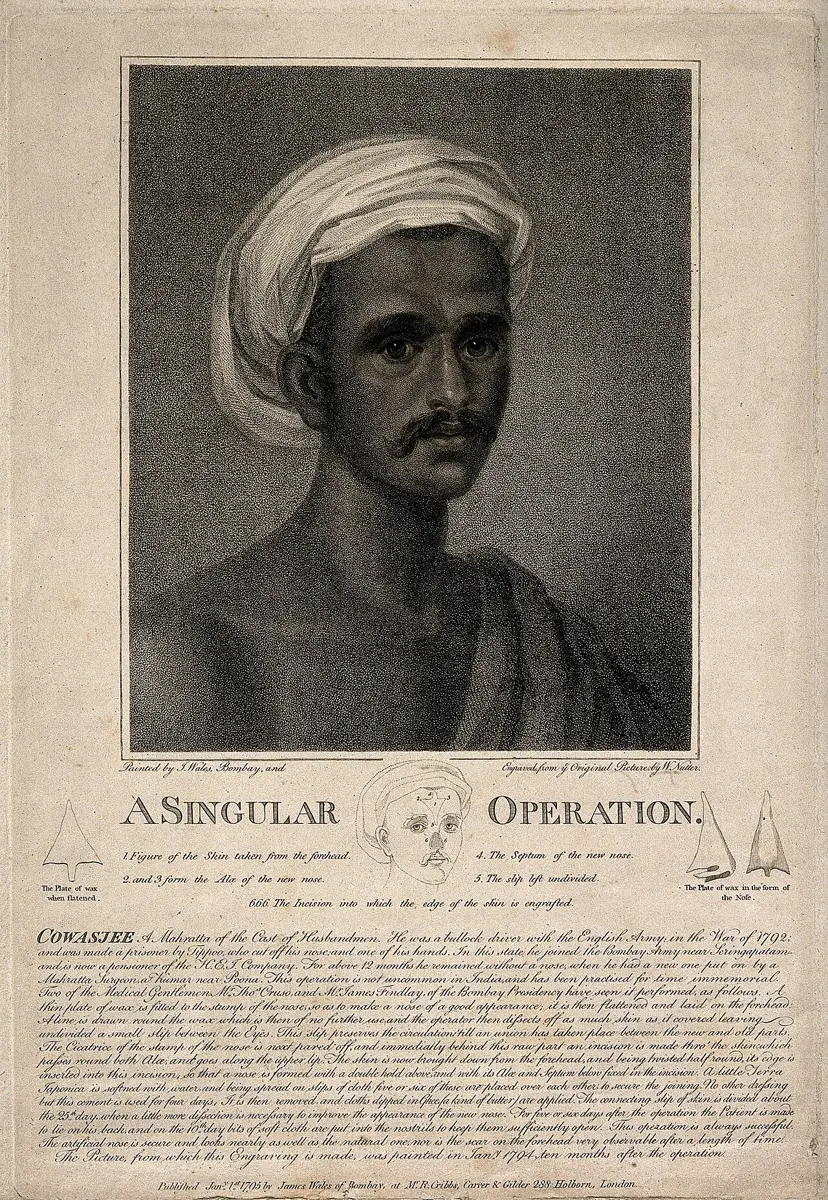
In 1792, during a war between the British East India Company and Tipu Sultan, the ruler of Mysore, a bullock driver named Cowasjee, working for the British army, was taken prisoner. Tipu had his nose and one of his hands cut off. For more than a year he lived without a nose. Then, near Poona, today’s Pune, a craftsman gave him a new one. The Gentleman’s Magazine of London printed the story in October 1794, in a letter signed only “B. L.”, with an engraving of Cowasjee’s face. The operation, the letter said, “is not uncommon in India, and has been practised from time immemorial.” Two British doctors in Bombay, Thomas Cruso and James Findlay, had seen it done, and described it.
A thin plate of wax was shaped to the stump to make a nose of a good appearance, then flattened and laid on the forehead. The operator cut round it and lifted that much skin, leaving a narrow strip uncut between the eyes, so that blood could still reach the new skin until it took. He pared the old scar, brought the skin down with half a twist, and tucked its edges into a cut round the nostrils. Strips of cloth with a plant paste held it, then cloths dipped in ghee, and around the twenty-fifth day the strip between the eyes was cut. The new nose, the letter said, looked almost as good as a natural one.
The two methods differ. The सुश्रुत संहिता takes skin from the cheek, and cuts round a leaf. The Poona craftsman took it from the forehead, and cut round wax. Nobody has shown that he or his teachers ever read the book. The letter calls him a man of the brickmakers’ caste: his skill was kept among craftsmen, not Sanskrit scholars. What the two share is the idea of mending a face with the patient’s own living skin. The strip left joined between the eyes, so the new skin kept its blood, is the craftsman’s, as the letter describes it. Whether the book’s cheek flesh also stayed joined is argued, since its words can be read either way; for a new earlobe, it plainly does.
Europe had a way of its own: in the 1590s the Italian surgeon Gaspare Tagliacozzi published a book on rebuilding noses with a flap of skin from the upper arm. The 1794 letter showed European surgeons a different way.
One of them was Joseph Carpue, a London surgeon. On 22 October 1814 he tried the Indian method on an army officer whose nose had been destroyed by mercury, then a common medicine. The operation took about fifteen minutes, with no anesthetic. In 1816 he published An Account of Two Successful Operations for Restoring a Lost Nose from the Integuments of the Forehead. A German surgeon, Carl Ferdinand von Gräfe, is credited with the name the new branch goes by: plastic surgery, from a Greek word for shaping. The forehead flap, still called the Indian method, is today one of the standard ways surgeons rebuild a nose.
What every surgeon lacked
Carpue’s patient went through fifteen minutes of having his forehead cut, wide awake. Nearly every surgeon in the world worked like that until ether came into use as an anesthetic, in 1846. And even after a successful operation, patients often died days later of infection, because nobody knew that germs on hands, instruments and dressings were the cause. In the 1860s Joseph Lister, a British surgeon, began killing germs with carbolic acid during his operations, and within three years the death rate among his patients fell from almost one in two to about one in seven.
The सुश्रुत संहिता had neither. Its surgeons offered wine, and explained a wound that went bad by the three दोष, the theory Chapter 7 describes. Their oils, ghee and caustic pastes may have helped some wounds; there is no way now to tell which. The book’s surgery could be brilliant in its handwork and still dangerous for the patient, as all surgery was then.
So the plain picture is this. The सुश्रुत संहिता is ancient India’s great book of surgery, made in layers over several centuries. It taught practice on gourds and dolls before touching a patient, anatomy from a dead body seen with your own eyes, the right instrument for each job, couching for cataracts, and new ears and noses from the patient’s own flesh. Its oldest dated copy, made in 878 CE for a physician of Deopatan, is in Kathmandu. And an Indian nose operation reported in 1794 shows how an old practice becomes modern medicine: not because it is old, but because surgeons could see that it worked, tried it themselves, and found it did.
Found a mistake? Please tell us.