
One of the oldest medical books in the world has a problem to solve. A doctor, it says, should use every one of his senses on a patient: listen to the body, look at it, touch it, smell it. But not taste it. So how is he to know whether a patient’s body has turned sweet? The book’s answer is to watch the flies. If flies keep settling on someone, their body is sweet. If lice crawl away from someone, their body has turned unpleasant. And if a doctor isn’t sure whether blood a patient has lost is healthy, he can offer it to a dog or a crow. If they eat it, it is good blood. If they won’t touch it, it is not.
It sounds odd, and some of it is. But it shows something true about the old physicians of South Asia. They were trying to find out what was happening inside a body they could not see into, with nothing but their own senses and their reasoning, and they took the job seriously. The way they examined a sick person, and how well it holds up when it is tested, is what this chapter is about.
Using every sense
The book is the चरक संहिता (Caraka Saṃhitā), Charaka’s book, one of the two oldest of Ayurveda. It says a physician has three ways of knowing anything about a disease. The first is the word of people who know, which for Charaka means the teachers and the old books. The second is what he observes for himself. The third is inference, working out what can’t be seen from what can.
Observing comes with a list. With his ears the physician listens for the gurgling of the gut, the cracking of the joints and the fingers, and the patient’s voice. With his eyes he looks at color, shape, size and complexion, and at whatever has changed. With his hand he feels whether the body is warm or cold, rough or smooth, dry or moist, as it naturally is or as the illness has made it. With his nose he smells the whole body. Taste is the one sense he leaves out, which is why the flies come in, and why the patient is simply asked what taste is in their mouth.
Inference does the rest, and Charaka is clever about it. Some things can never be seen directly, so he names what shows them. You judge a person’s digestive fire, अग्नि (agni), by how well they digest. You judge their strength by how much exercise they can take. Fear shows in despair, anger in hostility, a good memory in remembering. And some things can only be learned by asking: what the patient dreams, what they like and dislike, what gives them pleasure or pain.
The other great early book, the सुश्रुत संहिता (Suśruta Saṃhitā), counts six ways to examine a patient: the five senses and questioning. It is the book that shows most clearly what all this watching could find. It sorts one family of urinary diseases, प्रमेह (prameha), into twenty kinds by what the urine looks like. One is clear like water, one like sugarcane juice, one is the color of wine, one leaves fine sand behind. In one kind the urine looks like honey and tastes sweet. And among the signs that the disease is getting worse, the book lists the urine being swarmed by flies.
That is very likely diabetes, seen from the outside: a body that passes sugar in its urine, noticed because insects came to it. Doctors today would not use flies. But the observation was real, and it was made without any laboratory at all.
Ten things about the patient
Examining the disease was only half the job. Charaka says the physician must also examine the patient, and he gives a reason that any doctor would accept. Medicines have different strengths, and patients do too. A strong medicine given to a weak patient who hasn’t been examined properly can kill them. A mild one given to a strong patient with a serious disease will do nothing. So before giving anything, you find out what kind of person is in front of you.
For that he lists ten things to examine. The patient’s natural make-up, their प्रकृति (prakṛti), the mix of the three दोष (doṣa) they were born with. What has gone wrong, the illness itself. The quality of their tissues. How compact and well-knit the body is. Its measurements. What they are used to. Their strength of mind. How much they can eat and digest. How much exercise they can do. And their age.
Some of these are surprisingly specific. Charaka measures the body in finger-breadths, each person by their own finger, so the measure grows with the person. The head is sixteen fingers high, the hand twelve fingers long, the whole body eighty-four fingers tall, and someone with those proportions, he says, will be strong and long-lived. Strength of mind gets a fine observation: a person with a strong mind, even in a small body, can bear great pain without distress, while a person with a weak mind, even in a big body, can’t bear even a little.
CDC’s Grade 10 Ayurveda book teaches this tenfold examination, the दशविध परीक्षा (daśavidha parīkṣā), with Nepali examples: someone who sweats a lot in the heat feels better in a cool place, and people living in the high mountains are more likely to suffer illnesses of the cold. Its list differs a little from Charaka’s, adding the season and the place where the patient lives, which Charaka examines separately.
Eight places to look
The list a वैद्य (vaidya), a doctor of Ayurveda, is most likely to use today is a shorter, later one, the eightfold examination, the अष्टविध परीक्षा (aṣṭavidha parīkṣā). It isn’t in Charaka’s or Sushruta’s books. It comes from a later handbook, the योगरत्नाकर (Yogaratnākara), and CDC’s Grade 10 book teaches it as the standard. The eight are the pulse, the urine, the stool, the tongue, the voice, the touch of the skin, the eyes and the look of the body.
Most of them are what any careful doctor still checks. CDC’s examples are plain ones: a fast pulse may mean fever, a white coating on the tongue a problem with digestion, a weak voice a weak patient, yellow skin jaundice.
Urine had a test all of its own in the later books. In the oil-drop test, तैलबिन्दु परीक्षा (tailabindu parīkṣā), a drop of sesame oil is let fall onto a patient’s urine, collected early in the morning, and the physician watches how it spreads. One handbook says that a drop that takes the shape of a snake means a disease of वात (vāta), an umbrella one of पित्त (pitta), and a pearl one of कफ (kapha). Other shapes were read for what would happen next. A drop that spreads quickly means the disease can be cured. One that sinks to the bottom means it can’t. A swan, a lotus or an elephant is a good sign; a sword, a bow or a headless body is a very bad one. Ayurvedic researchers who studied the test describe it as very popular in the medieval period and out of use after the seventeenth century. They also found that how the oil spreads depends on things that have nothing to do with the patient: how long the urine has stood, how high the drop falls from, which sesame oil is used, and the size of the dish.
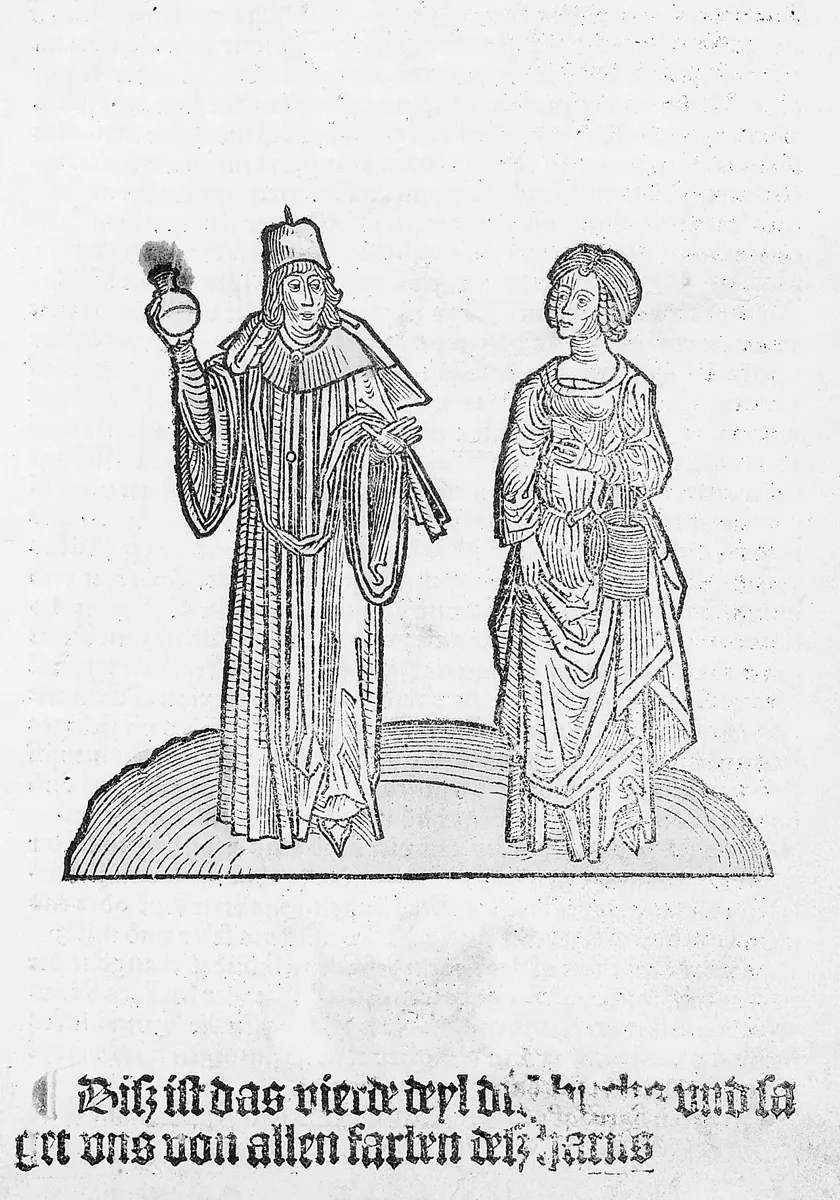
Europe’s doctors were looking at urine too. A fifteenth-century German woodcut shows a physician holding urine up to the light in a glass flask, a woman with a basket beside him. Wherever there were doctors and no laboratories, urine was one of the few windows into the body that anyone could open.
The pulse
The most famous part of the eightfold examination came late. Neither Charaka nor Sushruta describes reading the pulse as a way of finding out what is wrong. It is set out in later handbooks, among them the शार्ङ्गधर संहिता (Śārṅgadhara Saṃhitā).
In those books the physician feels the pulse at the wrist, at the root of the thumb, with three fingers side by side. Under the index finger he feels वात, under the middle finger पित्त, under the ring finger कफ. CDC’s Grade 10 book likens each to a creature. A pulse strong with वात is said to wind like a snake, one strong with पित्त to jump like a frog, one strong with कफ to glide slowly like a हाँस (hā̃s), a swan or a duck. The शार्ङ्गधर संहिता adds that the pulse runs fast with desire and anger and slow with grief and fear, quickens when digestion is strong, and is irregular in a hungry person.
Some of that a modern doctor would recognize at once. The pulse does change with emotion, with fever, with exercise and with food. What modern medicine reads in it is its rate, its rhythm and its strength, and those are real and useful: a fast, irregular or weak pulse tells a doctor something true about the heart. What the old texts added was a second, finer reading, in which each finger feels a different दोष. That second reading is the one that has been put to the test.
Chinese medicine reads the pulse too, in a tradition of its own, and so does Japanese.
Does it agree?
So how would anyone test a way of examining people? Not by asking whether it feels convincing, but by a simpler question first: do two good examiners, looking at the same person without comparing notes, come to the same answer? If a reading is a real feature of a person, they should, the way two nurses weighing the same child get the same weight. A reading that changes with the examiner can’t be telling you much about the patient.
That is what one study did. Fifteen registered Ayurvedic doctors, with three to fifteen years of practice each, examined the same twenty healthy young people one at a time and wrote down what they found in the pulse, the tongue and the person’s प्रकृति. The researchers then compared every pair of doctors, 105 pairs in all. For प्रकृति, the doctors agreed a little more often than chance, and twelve of the pairs did clearly better than guessing. For the tongue, no pair did clearly better than guessing. For the pulse, one pair did. The researchers called the reliability low for all three. Chapter 7 tells the same study for प्रकृति; here what matters is that the pulse, the reading most people think of first, came out the weakest.
A second study asked a different question: does one expert agree with himself? An Ayurvedic doctor known for his skill in pulse reading examined seventeen healthy people twice, in a random order, without seeing them. His two readings of the pulse agreed moderately well, and his two readings of their constitution agreed better still. So one skilled examiner can be fairly consistent with himself, even when different examiners disagree with each other.
The oil-drop test has had only small studies, by researchers within the tradition, who compared what they saw with what the books say and found that it often matched. Their reports don’t say whether the people reading the drops knew who was healthy and who was ill. No study we could find has given pulse readers or oil-drop readers patients whose illness had been found by other means, without telling them, to see how often they name it correctly. Agreement is the first step, and even a reading that two doctors agree on could still be wrong. That second test hasn’t been done.
None of this is a special embarrassment for Ayurveda. Every way of examining people has to pass the same check, and modern medicine has applied it to itself. Doctors who reviewed the evidence found that the ordinary physical examination taught in medical schools includes many signs that are only partly accurate and that different doctors read differently, something that, they wrote, may not be appreciated. A review of Chinese and Japanese medicine found the same kind of thing: some studies of pulse reading show good agreement and some poor, and tongue reading varies a lot from examiner to examiner.
And one part of the old examination has done well when tested. In one study of 80 new patients at a medical outpatient clinic, the physicians wrote down a diagnosis after reading the letter that sent each patient, again after taking the history, and again after the physical examination, and compared each with the diagnosis that stood two months later. In 66 of the 80 patients, the letter and the history had already given it. The examination added the right answer in seven more, the laboratory in seven more. In that study, at least, listening to the patient and asking the right questions did most of the work. Charaka, who told the physician to learn by asking what could be learned no other way, would not have been surprised.
So the picture is this. The old physicians built a careful, many-sided way of examining a sick person, using every sense but taste, judging the patient’s strength before choosing a medicine, and asking questions. Much of that is what good doctors still do. The later, finer readings, the दोष felt under three fingers and the shapes of oil on urine, are different: when they have been tested, different examiners haven’t agreed on them, and whether they find what they claim to find has never been fairly tested at all.
Found a mistake? Please tell us.